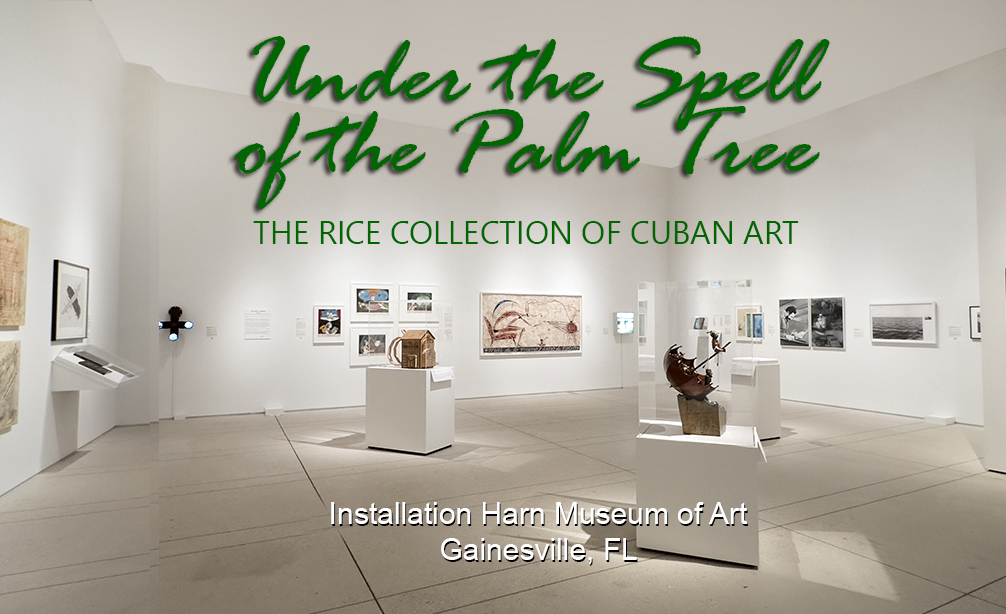
Following acclaimed presentations at the Harn Museum of Art and the
Tampa Museum of Art, Under the Spell of the Palm Tree: The Rice Collection
of Cuban Art (Bajo el hechizo de la palma) is now avaiable for circulation to museums world wide.
Organzed by the Cuban Arts Group, the exhibition is drawn exclusively from the collection of Susie and Mitchell Rice and offers a glimpse into the complexity of culture and history that has inspired Cuban art throughout the 20th century and into the 21st century. Guest curators Gabriela Azcuy and David Horta utilized the work of a broad range of artists in the Rice Collection to display an inclusive view of Cuban art, reflecting on its current dynamic and the existence of new geographies as an essential part of its reality. Through 70 works representing 51 artists, the exhibition presents the narrative of a “crossing”—a virtual crossing of the seas as well as a crossing of generations, of artists living or having lived both in Cuba and in the Diaspora.
Artists in the exhibition include modern masters (Cundo Bermúdez, Mario Carreño, Salvador Corratgé, Carlos Enríquez, Wifredo Lam and René Portocarrero), members of the so-called “generation of true hope" of the 1970s (Pedro Pablo Oliva and Roberto Fabelo), the “Cuban renaissance” generation of the 1980s (José Bedia, René Francisco Rodríguez, Eduardo Ponjuán and Lázaro Saavedra), the generation of the 1990s (Tania Brugueras, Belkis Ayón, Carlos Garaicoa, Sandra Ramos, Esterio Segura), as well as younger artists who have gained international visibility (Adrián Fernández, Reynier Leyva Novo and Mabel Poblet).
Dedicated to enriching and strengthening cross-cultural connections through the arts of Cuba, The Cuban Arts Group, a 501 (c)(3) non-profit organization, is a collaborative effort between those passionate about the arts, and history, from the U.S. and Cuba. Founded in 2015 by Susie and Mitchell Rice, The Cuban Arts Group builds on the cultural evolution that has taken place—and continues to grow—both on the island and throughout the U.S. Cuban diaspora. The organization’s mission is to educate Americans about Cuban arts and culture through exhibitions and a diverse educational arts programs involving Cuban artists, art educators, curators, historians and writers.
Under the Spell of the Palm Tree: The Rice Collection of Cuban Art traces the Rice family’s decade-long path of discovering the art and artists of Cuba. This inaugural exhibition drawn from a collection of 236 works of art presents 70 paintings, drawings, photographs, prints, mixed media, art books, and sculptures by fifty-three artists selected and organized along six themes: The Language of Forms and the Forms of Language; The Prophet’s Dream; The Great Journey; Sensory Landscapes of Memory and Desire; The Musings of Narcissus; and The Spirit of the Real, the Reality of the Spirit.
The exhibition deviates from a traditional historical narrative and is presented as a compass rather than a timeline―a map for a journey through the varying themes, genres, and styles that align with the sensibilities of two generations of collectors in the Rice family.
The guide for this winding course of visual and conceptual ideas is the family’s unwavering admiration of Cuban artistic culture―epitomized here by the royal palm tree, the unifying symbol of ‘Cubanness.’ Their esteem for the art and the people of Cuba brings meaning and bestows consistency to the collection, making a strong whole of the multiplicity of parts.
The six thematic sections in Under the Spell of the Palm Tree wind through the exhibition space like convolutions of the brain, articulating individual yet functionally inseparable hemispheres. The analytical and cynical coexist with the emotional, intuitive, spiritual, and fantastical.
On one side, artists express an acute engagement with Cuba´s history, society, and culture. Their work centers on the utopias and dystopias found in the myths and aspirations of the Cuban psyche against a backdrop of totalitarianism, freedom fights, and migration.
But another direction along the pathway reveals an undertone of sensuality, imagination, and wit, a reconnection with nature, a search for self-awareness and transcendence, a personal ideal of art and beauty that is both abstract and concrete.
Taken together, the art within the exhibition―and in The Rice Collection as a whole―comprise a complete topography of shared imagery, symbolism, ideals, and allegories.
Gabriela "Gaby" Azcuy (b. Havana, Cuba, 1989) is an art curator, cultural manager, editor, and lecturer. She holds a Bachelor’s degree in Art History and a Master’s in Curatorial Studies, both earned with honors. In 2016, Azcuy began her tenure as curator for the non-profit organization The Cuban Arts Group and The Rice Collection, where she currently serves as chief curator. With over a decade of experience, she has curated more than thirty exhibitions and events across Cuba, the United States, and Europe, and her work bridges academic research, international collaboration, and the promotion of contemporary Cuban art.
David Horta (b. Pinar del Río, Cuba, 1973) is an independent curator, writer, and lecturer with expertise in film curation, archiving, and translation. He holds a degree in Education Sciences and has pursued postgraduate studies in cinema theory, art valuation, and conservation. Horta currently serves as associate curator and advisor for The Cuban Arts Group and Latin Art Core Inc. He has collaborated on numerous curatorial projects focused on Cuban and Latin American art and film, and his critical writings have appeared in art journals, catalogs, and cultural publications.
THE LANGUAGE OF FORMS AND THE FORMS OF LANGUAGE
Abstraction as Logos and Ethos, from Aesthetics to Politics |
The broad spectrum of art in The Language of Forms and the Forms of Language unveils the evolution of abstraction in Cuban art over more than seventy years. Divergent artistic sensibilities are connected through congruence of process, materials, points of departure, and artistic objectives. The growing affinity for abstraction among Cuban pioneers of modernism in the late 1940s is disclosed in selected early work in this section.
Abstraction was in vogue in Cuba from the early 1950s to the first years following the Cuban Revolution of 1959. But hardliners in the revolutionary cultural establishment condemned abstract art―and the artists who made it―with such epithets as “alienating,” “cold,” and “foreign,” and most especially, “bourgeois.” The disciplined and aseptic style labeled “concrete” was suppressed. The establishment ignored the spirit of innovation of Concrete Art and demanded conformity to standards of art and culture as defined by themselves.
This section discloses an interval between twentieth-century abstract art and the more narratively oblique, ambivalent, or openly critical abstraction that followed. The later work is infused with political innuendo and veiled references. Abstraction became the language used by artists to express ideas in conflict with the regime.
In The Rice Collection, abstraction is revealed as a salient visual and conceptual element of the continuum of Cuban cultural eras, social generations, and political frames of reference.
The works in The Prophet’s Dream express political and social awareness and illustrate the communal Cuban identity of the generations that followed the Cuban Revolution of 1959.
The concept of abstract entities such as motherland, national identity and values, culture, “a people”, revolution, and shared destiny rely upon regulated thought. An exaggerated sense of political stability and social cohesion, communal well-being and aspirations, and a perception of belonging and predestination are inherent in this thinking. These paradigms are founded upon imagined realities, instilled fictions, and embraced beliefs.
Art has served throughout history as an effective tool of propaganda, amplifying fictions through repetition, aggrandizement, and emotional provocation.
But if the veracity of a story is doubted or rejected, art can become a call to reason and a tool for exposing discrepancies between reality and rhetoric, wakefulness and dreams, and utopia and disillusionment. It can reveal the inconsistencies in a narrative and the glitches in a fictional matrix. Art can bring into focus and scrutinize ideas previously blurred, omitted, or completely expunged.
In opposition to propaganda, art that employs irony, satire, double entendre, veracity in documentation, and historical honesty puts a belief system into question.
In the works of The Prophet’s Dream, art serves to express uncertainties, anguishes, and doubts most eloquently.
THE GREAT JOURNEY
Archives
The works in The Great Journey: Archives express the trauma of national exile.
Cuba is defined as an island-nation, a term that refers not only to its geographic properties―the cluster of islands, islets and keys that form the biggest archipelago in the Antilles―but also the people who inhabit it.
Spiritually and culturally speaking, Cubans consider their country to be a more capacious island-nation, one that encompasses its people wherever they may be. Displaced Cubans, scattered across the globe for more than six decades, comprise an implicit constellation of Cuban islets, defined by identity, not location. They maintain connection through memory, language, family, the experience of suffering, the longing for liberty―and their undying and unrequited love of homeland.
This section reflects the trauma of sixty years of a nation being shattered by immeasurable loss through migration.
These works summon the essence of the Cuban exodus―the sad farewell to the beloved and familiar, the tribulations of a one-way trip to an unknown land, the challenge of adapting to an unfamiliar life―and embody one of the most recurrent topics in contemporary Cuban art.
THE SENSORY LANDSCAPES OF MEMORY AND DESIRE
The more hedonistic, chimerical, and whimsical imagery percolating through Cuban contemporary art is found in The Sensory Landscapes of Memory and Desire. These works exude eroticism, playfulness, perceptual games, intimate longings, the unconscious, and explorations into the depths of memory.
The nomadic spirits of the Cuban avant-garde―those moving between Havana, Paris and New York in the early 20th century―began distilling the elements of a fabricated Cuban identity in their art. They constructed imaginary topographies of bucolic rural scenes, visual tropes charged with vivid colors and sensuality, and thrumming city scenes―an idealized portrayal of an unrealized tropical utopia.
These artists contorted the natural beauty of Cuba into a romanticized version that persuaded natives and foreigners alike. Their idealized imagery, in which corruption is erased and ambiguity absent, insinuated itself as the stereotypical idea of the island both at home and abroad.
Through the decades following Castro’s Revolution in 1959, some artists established residency abroad. Their art was imbued with the pulse of their cosmopolitan life and the aggressive rhythm, fevered consumerism, and formidable geometrical order of urban architecture. The work from this period oscillates between awe of the locale―expressed in vibrant cityscapes―and rebuff of the new environment. Rejection of the new surroundings found expression in criticism, fabricated mindscapes, and idyllic renditions of a mythical and lost island life.
For many of the artists who remained in Cuba after 1959, artistic expression became a different kind of political struggle―that of claiming a place of true individual freedom beyond the constraints and limitations of circumstances. In a country of inescapable scrutiny of one’s political standing, and against the predominantly political post-revolutionary art, these artists dissent and delve into the realm of the self. Their work, at once conceptual and anecdotal, both reminisces and ruminates on the anodyne―art-making, sex, nature, and all matters of everyday life. Through the lenses of imagination, poetry, and deeply felt emotion, this work transcends its origins in the commonplace and rises to distinction.
THE MUSINGS OF NARCISSUS
Through the Looking Glass and What the Artist Found There
The Musings of Narcissus: Through the Looking Glass and What the Artist Found There offers a glimpse into the process and philosophy of Cuban artists exploring self-representation.
In the 1980s Cuban artists began to center on the self, revealing intimate feelings and emotions. They explored both philosophical and material aspects of the creative process and circumvented previous intellectual and artistic confines. The self-referential movement criticized, rejected, and deconstructed traditional means of expression. Their quest for discovery of original and eloquent ways of expression ultimately transfigured the artist’s role entirely.
The body of art created in this trend delineates curiosity and self-scrutiny, the narcissism of self-contemplation, playful idealizations, and allegorical renderings of autobiography. Some of the artists sublimate their personal psyche and fabricate alter egos to address the contradictions inherent in the intellectual process of art-making.
The practices and viewpoints of self-awareness and referentiality that emerged in this movement powerfully persist in contemporary Cuban art.
THE SPIRIT OF THE REAL, THE REALITY OF THE SPIRIT
The myriad of individual styles, aesthetics, and imagery in the work in The Spirit of the Real, the Reality of the Spirit is bound by a common genesis in the sacred.
It is within a spiritual dimension that these artists’ conceptual understanding of the ultimate substance, meaning, and purpose of their art―as well as of the world around them―is primarily charted and expressed.
The art may be guided―or at times executed using the artist as a vessel or a tool―by spiritual beings such as gods, friendly or evil spirits, souls of ancestors, or other presences that inhabit the artist’s life and dreams. The artists’ own understanding of the meaning unfolding in their work―and the process of delineating images they envision, however secular the subjects―is mediated by these otherworldly entities.
In most of the works in this section, mythological and symbolic elements from African-Cuban religions underlie or are dominant in both the narrative and the visual structure of the works.
Some narratives convey an assertion of identity, while others serve as allegories, as the artists question or testify to a spiritual view of personal or social issues.
THE RICE COLLECTION
Susie and Mitchell Rice have been spiritually enriched by their relationship with art and artists, ever more profoundly as their collection expands and evolves. We can trace its itinerary back to the earliest travels of these tireless wanderers, both at home and overseas. Every new trip would yield not only photographs and memories, but often a painting or a print from a local artist.
When it comes to art, the family’s first visit to Cuba in 2013 was as memorable as it was pivotal to their vocation as collectors. Cuban art became a gateway to embrace the heart and mind of a fascinating culture and its people. Collecting was no longer a hobby, but a passion, and over time the Rices would fall completely “under the spell” of Cuban art.
For a decade, Susie and Mitchell’s Cuban Art Collection has been growing consistently in scope and quality, now treasuring the works of more than seventy artists from different generations and aesthetics. It has become an always open, living process; a voyage of self-discovery that goes beyond the sheer pleasure of finding, acquiring, treasuring, and enjoying the contemplation and discussion of artworks in the company of relatives and friends. Sharing ideas and experiences with artists and fellow collectors has become a ritual that deeply enriches the practice of collecting, while also sparking connections with new friends and advocates. Thus, the Rice’s quest has progressed from spontaneous and intuitive exploration to knowledge…from serendipity to conscious search…from enjoyment to commitment…all culminating in a strong emotional bond.
Susie and Mitchell Rice are dedicated to “expanding and enhancing the collection’s ability to represent the breadth and richness of Cuban art.” They wish to share their collection with the public “through thoughtfully curated exhibitions and a diverse educational arts program,” as well as via loans and the publication of books, among other initiatives that will help to make Cuban art and artists more visible beyond the nation island. This is the impetus behind their creation and continuous support of the non-for-profit foundation, The Cuban Arts Group.
As a vision for the future, it is Susie and Mitchell Rice’s aspiration, in their own words, “to create a permanent exhibition platform, such as a museum or cultural center. By way of such a public setting, it would be our dream to share our passion for Cuba, its complexity, rich culture and history, all as documented through the eyes of Cuban artists.”
|